LOADING...
Building intelligent systems at the intersection of
|
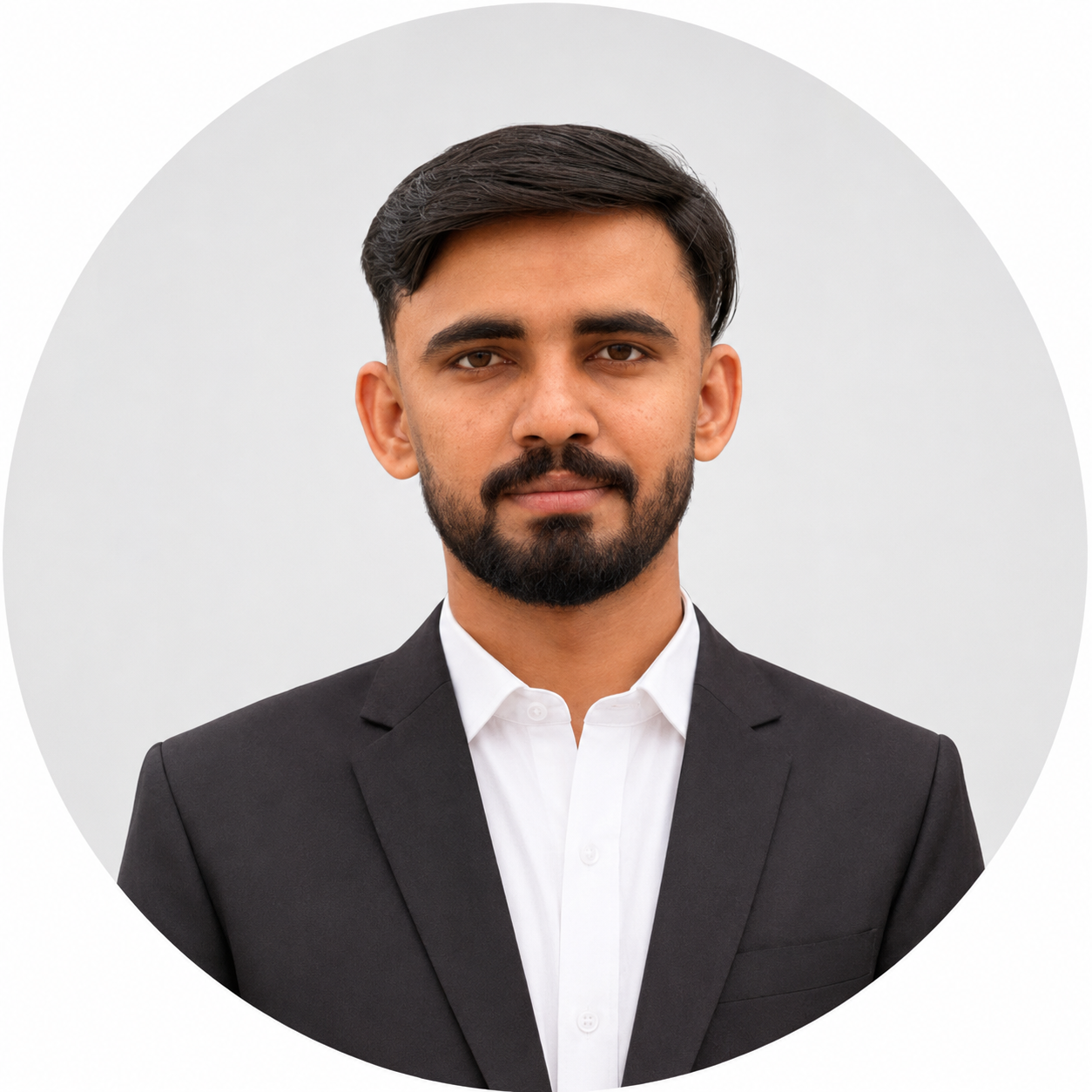
I'm a Mechanical Engineering student at PIEAS University who fell in love with intelligent systems — operating at the crossroads of physics, data, and machine learning.
My work spans computer vision for real-time human tracking, predictive maintenance via deep learning on vibration/sensor data, fault detection using Vision Transformers and Mamba SSM, and mechanical design from gear trains to pump diagnostics.
From PINNs optimized by whale algorithms to turbofan RUL estimation — I treat every problem as an engineering challenge: systematic, data-driven, built to last.
{
  "name": "Muhammad Own Raza",
  "university": "PIEAS University",
  "focus": ["CV", "Predictive Maintenance", "Fault Detection"],
  "citations": 2,
  "h_index": 1,
  "publications": 4,
  "status": "open to opportunities"
}From pixel-perfect book covers to AI systems powering real companies.
Freelance · Remote
Self-directed transition
Contract · Remote
Active · Freelance
AI-powered predictive maintenance for Turbofan Engines. Detects anomalies and estimates remaining useful life (RUL) using deep learning on N-CMAPSS multi-sensor data streams in real time.
Real-time computer vision toolkit: 468-landmark Face Mesh, Hand Tracking (21 keypoints), Pose Estimation (33 landmarks), and Air Writing Canvas. Built with OpenCV & MediaPipe.
Multi-Scale Vision Transformer + Dual-Frequency Mamba architecture for rotating machinery fault detection. Combines global attention with Mamba's efficient state-space sequence modelling.
Whale Optimization Algorithm-tuned Physics-Informed Neural Networks for cavitation fault detection in centrifugal pumps. Published research — merges physics priors with metaheuristic search.
Advanced Transmission Design Suite for mechanical system analysis, gear ratio optimization, drivetrain simulation, and performance characterization of multi-stage gearboxes.
Hands-on hardware — condition monitoring apparatus designed & built at PIEAS University.
Quick look at the custom-built apparatus — real-time vibration & sensor acquisition from rotating machinery in the PIEAS lab.
Full walkthrough of the condition monitoring platform — from sensor setup to data pipeline and fault detection output.
Peer-reviewed and pre-print research in AI, mechanical systems, and fault detection.
The real resume. Every rejection, every failure — and what came after.
"The strongest steel is forged in the hottest fire."
Most portfolios show only the wins. This one doesn't. Here is where I was forged.
Applied to one of Pakistan's most selective engineering universities. Rejected. At the time it felt like the end. In hindsight it was the first real engineering problem I had to solve: how do you build a career when the door you wanted is closed?
Year one was brutal — failed both semesters. I could have quit; most would. Instead I stripped everything back, rebuilt how I learn, and came back harder. Students who fail and return often understand material more deeply than those who never struggled.
Submitted research. Rejected several times. Reviewers: "insufficient novelty," "weak baselines," "methodology unclear." Each rejection came with pages of feedback that made the next version sharper, experiments tighter, writing cleaner. I eventually published.
Another rejection. Another late night rewriting, redoing experiments, questioning everything. The research was sound — the version wasn't ready. It will be.
This section exists because every engineer you admire has a graveyard of rejections. The ones who succeed aren't the ones who never failed — they're the ones who kept engineering anyway.
Open to research collaborations, engineering roles, and interesting problems.